
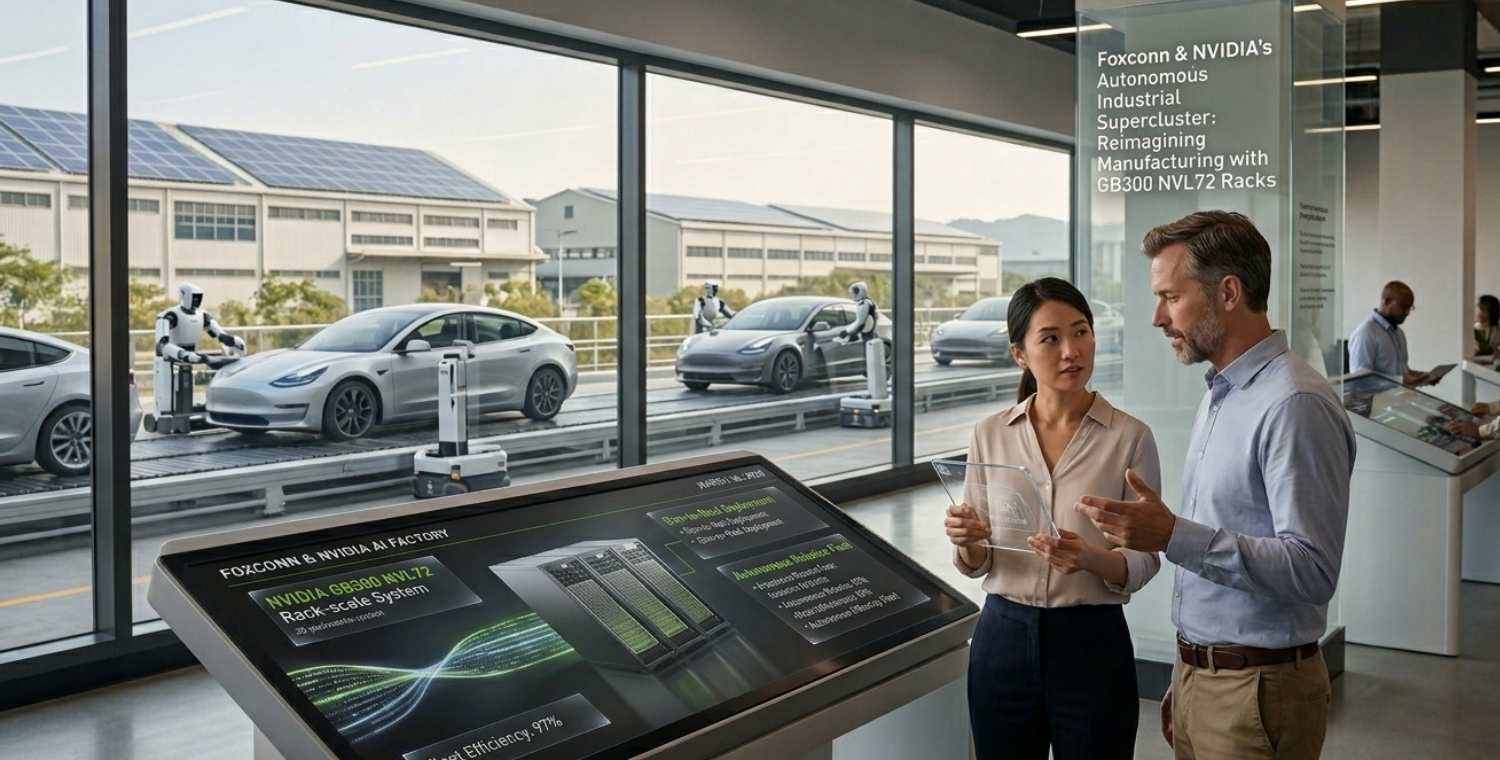
“Electronics manufacturing historically suffered from the structural rigidity of ‘fixed automation,’ a model that inherently resisted rapid changeovers and introduced persistent risks in quality assurance.” As global demand shifts toward hyper-complex AI servers and electric vehicles (EVs), the “Adaptability Gap” of traditional factories has become a massive bottleneck. High-mix, low-volume production requires a level of coordination that traditional software simply cannot handle.
On March 26, 2026, Foxconn (Hon Hai Technology Group) announced a massive infrastructure shift by deploying a $1.4 billion AI Supercomputing Center in Taiwan. By integrating 10,000 NVIDIA Blackwell GPUs, Foxconn is deploying the world’s first truly Autonomous AI Factory. This move shifts manufacturing away from “static assembly” and places it into a “Software-Defined” environment where robots and production lines learn and adapt in real-time.
The Challenge: The “Rigidity” Bottleneck in Manufacturing
In a global supply chain, a single part delay or a minor defect can halt a multibillion-dollar production line. Traditionally, quality inspections were done by humans or “dumb” cameras that couldn’t distinguish between a shadow and a scratch. The “Information Gap” meant that data from the factory floor took hours to reach the management level, making real-time course correction impossible.
Foxconn’s deployment solves this by creating a “National-Scale AI Cloud” that connects its global factory network. This allows Foxconn to run Industrial Digital Twins that simulate the entire manufacturing process—from the molecular structure of a solder joint to the logistics of 1,000 AI racks per week.
The Solution: The Blackwell-Powered “Industrial OS”
The centerpiece of this deployment is the NVIDIA GB300 NVL72 rack-scale system. By leveraging Blackwell’s exascale compute, Foxconn is building an “Industrial AI Operating System” in collaboration with Siemens.
Key Technology Deployment Pillars
| Pillar | Technology Integrated | Primary Function |
| Compute Layer | 10,000 NVIDIA Blackwell GPUs | Acts as the “Global Brain” for Foxconn’s automated assembly lines. |
| Simulation | NVIDIA Omniverse | Creates a “Virtual Twin” of the factory to test new layouts in minutes. |
| Robotics | NVIDIA Isaac Platform | Powers “SortBots” and “PickBots” that navigate and organize parts autonomously. |
| Connectivity | Quantum InfiniBand | Provides the ultra-high-speed data “arteries” between the GPUs and the robots. |
Phase 1: Deploying the “Sim-to-Real” Strategy
The first phase focuses on Virtual Commissioning. Instead of building a physical prototype of a production line, Foxconn builds it in the Industrial Metaverse.
- The Use Case: Setting up a new assembly line for “Model A” Electric Vehicles.
- The Action: The Blackwell-powered twin simulates millions of “what-if” scenarios—adjusting robot arm speeds and conveyor paths—to find the most efficient flow.
- The Result: Foxconn has reduced the time to set up new production lines by 30%, moving from “design to dirt” faster than ever before.
Phase 2: Solving the “Defect Crisis” with Vision AI
The second phase deploys Autonomous Quality Control (QC). Robots equipped with Blackwell-powered vision sensors inspect 1,000 parts per second.
- The Action: The AI identifies microscopic cracks in circuit boards that are invisible to the human eye, automatically rerouting defective parts for repair.
- The Result: Foxconn has achieved a 60% reduction in vehicle defects and a significant increase in first-pass yield for its AI server racks.
Operational Impact of Foxconn AI Factory (2026 Metrics)
| Metric | Legacy Manufacturing (2024) | Blackwell-Powered AI Factory |
| Production Speed | 100 Racks / Week | 1,000 AI Racks / Week |
| Defect Detection | Manual / Static Vision | Real-Time / Predictive AI |
| Setup Time (New Line) | 4–6 Months | < 2 Months (Sim-to-Real) |
| Energy Efficiency | High (Inefficient cooling) | 10x Higher Throughput per Watt |
Phase 3: The “Regional AI Hub” Advantage
In 2026, Foxconn is transitioning from a “Hardware Assembler” to a “Smart Solutions Provider.” By hosting this Blackwell cluster in Taiwan, they are providing Sovereign AI infrastructure for other industrial giants like TSMC. This ensures that the most sensitive industrial secrets—such as semiconductor yields and proprietary EV designs—are processed on secure, local hardware, protecting national intellectual property while maximizing global competitiveness.
The Results: A New Paradigm for Global Industry
Foxconn’s shift to a Software-Defined Manufacturing model is setting the blueprint for the “Industry 4.0” endgame.
- Deployment Success Summary:
- Hyper-Scalability: The ability to manufacture 1,000 AI racks per week has made Foxconn the primary backbone of the global AI boom.
- Waste Reduction: Digital twins have optimized material usage, reducing physical scrap by 15%.
- Robot Autonomy: Thousands of autonomous robots now operate “lights-out” (without human intervention) in select high-precision zones.
Conclusion: The Rise of the Living Factory
The deployment of NVIDIA Blackwell across Foxconn’s ecosystem marks the end of the “Static Factory” era. By bringing supercomputing to the assembly line, Foxconn is ensuring that the factory isn’t just a place where things are made—it’s a living, learning entity. In the future of manufacturing, the winner won’t just be the one with the most workers, but the one with the most intelligent and adaptable infrastructure.