
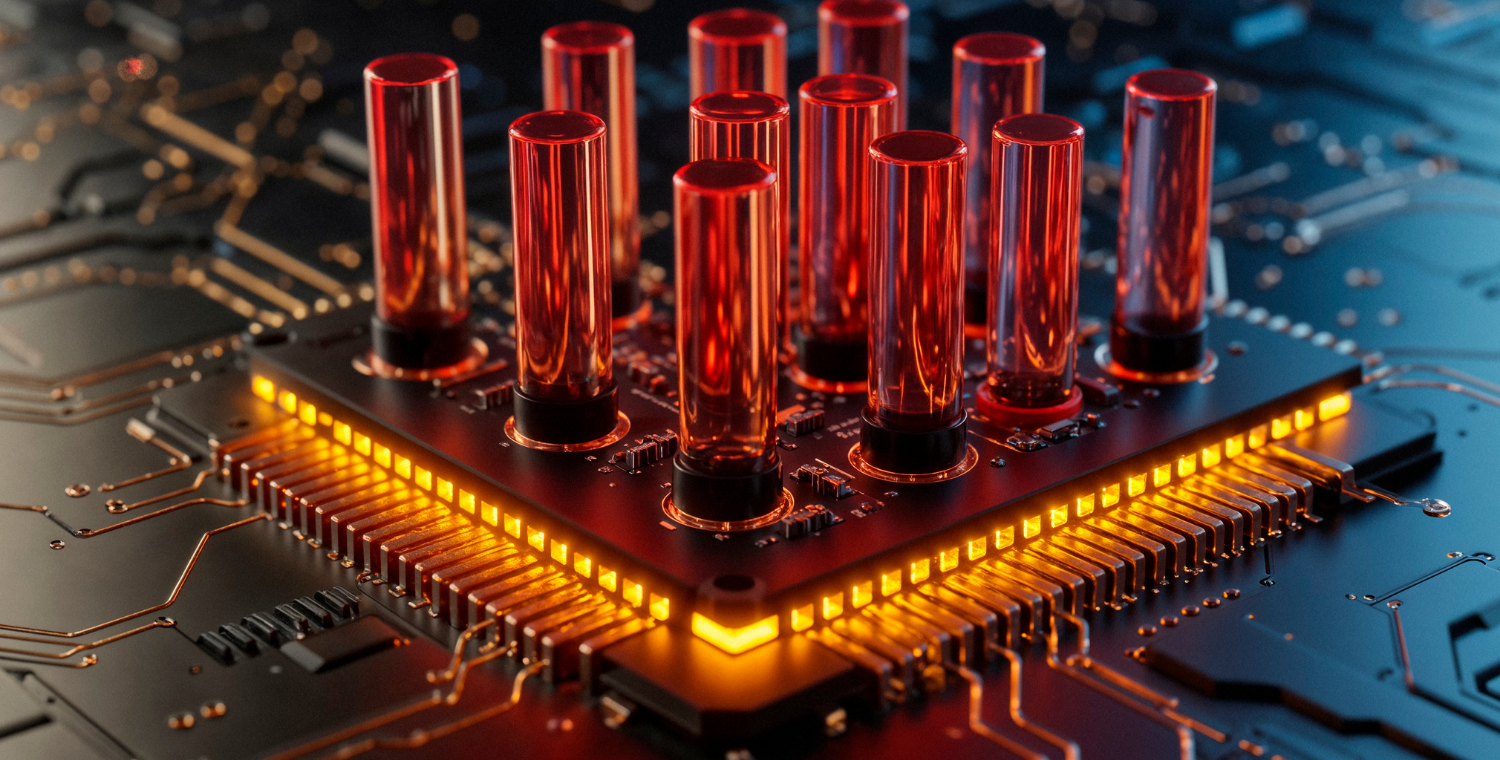
“Historically, laboratory productivity was capped by a reliance on manual precision, where the workflow was dominated by administrative and mechanical tasks that diverted focus from high-level scientific inquiry.” The “Instrument Bottleneck” meant that even the most expensive hardware sat idle while researchers struggled to interpret complex data streams. As biology entered its “Transformer Moment,” the need for a self-orchestrating laboratory became a prerequisite for global discovery.
On January 29, 2026, Thermo Fisher Scientific announced a strategic shift by launching an AI-Native Laboratory Ecosystem. By integrating NVIDIA Blackwell GPUs and BioNeMo directly into their next-generation mass spectrometers and sequencers, Thermo Fisher is creating the world’s first “Self-Driving Labs.” This move shifts the lab from being a collection of tools to a Connected Intelligence Flywheel.
The Challenge: The “Manual Discovery” Bottleneck
The core problem in modern life sciences is “Data Silos.” A high-end electron microscope generates terabytes of data, but that data often lives in isolation from the rest of the experiment. This “Integration Gap” forced scientists to act as human bridges, manually connecting hardware, software, and results. This not only slowed down the pace of discovery but increased the probability of human error in data interpretation.
The Solution: The Blackwell-Powered “Instrument-to-Insight” Stack
The centerpiece of this deployment is the integration of NVIDIA DGX Spark and NeMo Agents into Thermo Fisher’s digital foundation. This creates a “Modern Digital Foundation” where instruments are no longer passive tools but active participants in the scientific process.
Key Technology Deployment Pillars
| Pillar | Technology Integrated | Primary Function |
| Logic Layer | NVIDIA Blackwell GPUs (Embedded) | Provides real-time inference for “Intelligent Instruments” at the point of discovery. |
| Agent Factory | NVIDIA NeMo & BioNeMo | Powers “Autonomous Lab Assistants” that manage experimental workflows. |
| Data Layer | Thermo Fisher Scientific Cloud | Connects globally distributed instruments into a single, AI-ready data stream. |
| Orchestration | NVIDIA Holoscan | Enables high-bandwidth, low-latency processing of medical sensor data. |
Phase 1: Deploying “Intuitive Instrumentation”
The first phase focuses on Hardware Democratization. By embedding Blackwell-level compute into the devices themselves, Thermo Fisher makes complex research accessible to more scientists.
- The Use Case: Running a high-throughput drug screening experiment with autonomous feedback loops.
- The Action: The Blackwell-powered instrument identifies a promising molecular reaction in real-time and automatically adjusts the temperature and concentration for the next sample.
- The Result: Researchers can get more value out of every experiment, reducing “Trial-and-Error” cycles by 50%.
Phase 2: Solving the “Scientific Workload” Bottleneck
Thermo Fisher is using AI agents to remove the manual steps that traditionally bogged down the lab.
- The Action: Agentic Workflows autonomously manage data ingestion, vectorization, and recovery, ensuring that sensitive research data is always “AI-Ready” and searchable.
- The Result: Scientific staff report a 70% reduction in manual documentation and data management tasks.
Operational Impact of the Autonomous Lab (2026 Metrics)
| Metric | Traditional Lab (2023) | Thermo Fisher AI-Lab (2026) |
| Instrument Interactivity | Manual / Static | Intuitive / Agentic |
| Data Interpretation | Post-Experiment | Real-Time (In-Instrument) |
| Experimental Scale | Limited by Human Hours | Autonomous Discovery Flywheel |
| Discovery Accuracy | Human-Subjective | Mathematically Verified (Blackwell) |
Phase 3: The “Sovereign Research” Advantage
In the race for global health security, data sovereignty is paramount. Thermo Fisher’s deployment utilizes HPE Private Cloud AI air-gapped configurations. This allows researchers to use Blackwell-powered models like BioNeMo to design new molecules while ensuring that their proprietary genomic sequences never leave their secure, private infrastructure.
The Results: The “Flywheel” of Scientific Discovery
The Thermo Fisher and NVIDIA collaboration has fundamentally changed the “physics” of the lab.
Deployment Success Summary:
- Accelerated Life Sciences: The “Time-to-Insight” for complex proteomics has been reduced from months to days.
- Autonomous Efficiency: Laboratories are now running 24/7 with minimal human supervision, as AI agents handle the routine maintenance and calibration of hardware.
- Global Connectivity: By linking laboratory devices and data streams through an AI-native OS, scientists can now collaborate on exascale datasets across continents in near real-time.
Conclusion: Closing the Loop Between Dry and Wet Labs
The deployment of the NVIDIA Blackwell platform across Thermo Fisher’s instrumentation marks the end of the “Siloed Scientist” era. In 2026, the lab is no longer just a place of physical action—it is a Continuous Intelligence Loop. By mastering the “Ghost in the Code” of laboratory automation, Thermo Fisher is ensuring that the next generation of breakthroughs isn’t just a best effort—it is a high-velocity certainty.