
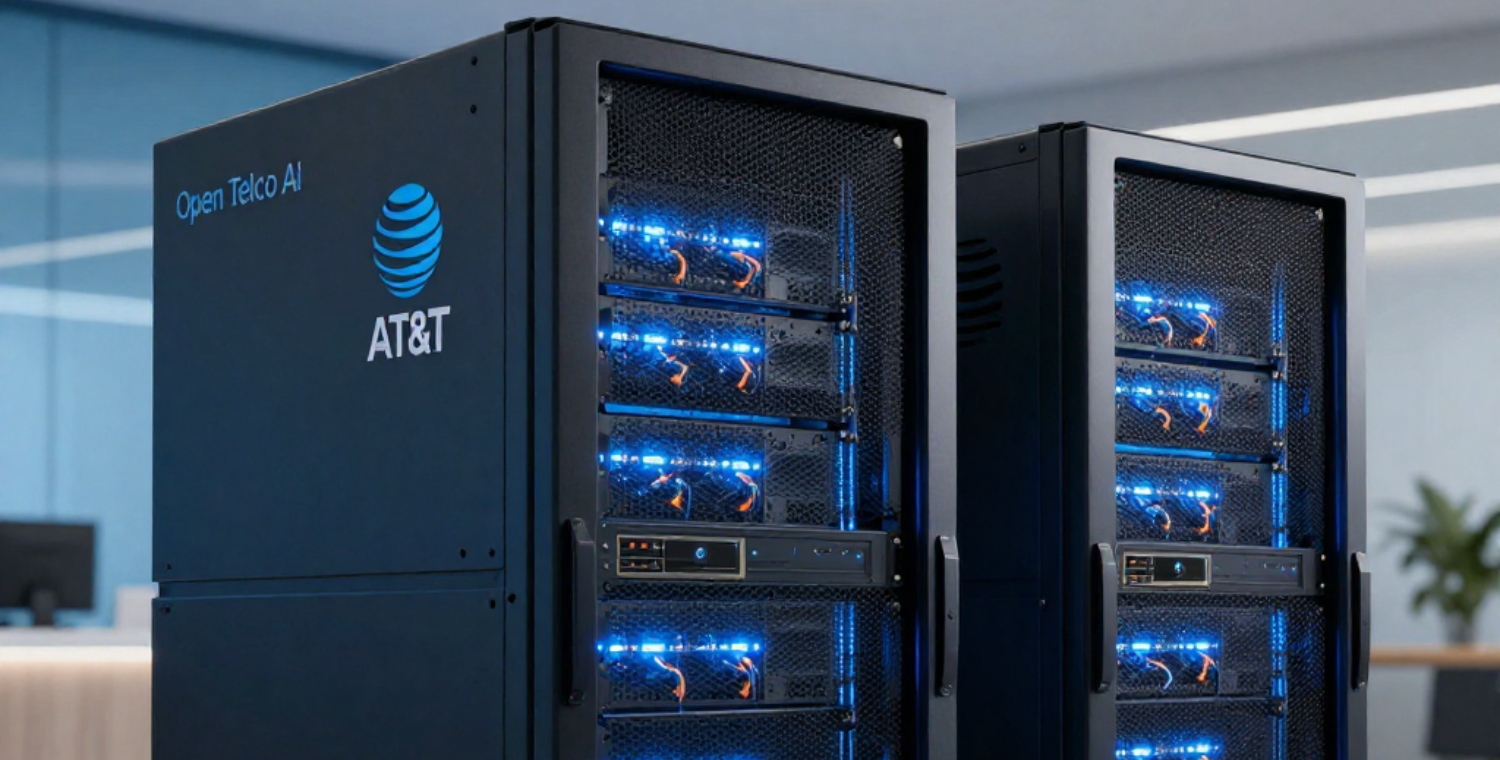
“Historically, telecom infrastructure was characterized by ‘black box’ limitations; these proprietary systems were fundamentally incompatible with the speed and flexibility required for modern network customization.” The “Operational Rigidity” meant that managing traffic spikes or deploying new features took months of manual configuration. The “Automation Gap” meant that while other industries scaled with software, telcos were still struggling with legacy hardware silos.
By March 2026, AT&T successfully scaled its “Open Telco AI” initiative. By backing an industry-wide open standard, AT&T has shifted from a “Proprietary Network Provider” to an “Open AI Infrastructure Operator,” where the network itself is software-defined and self-healing.
The Challenge: The “Complexity & Silo” Bottleneck
Managing 5G, Fiber, and IoT on thousands of different hardware components was a nightmare. When a network issue occurred, finding the “root cause” took hours of manual log analysis. The “Visibility Gap” meant that network outages were reactive, not predictive.
AT&T’s deployment solves this by using Agentic AI—a fleet of autonomous agents that constantly monitor, analyze, and “self-fix” the network fabric in real-time.
The Solution: The “Open Telco AI” Architecture Stack
The centerpiece is a disaggregated, cloud-native stack that separates hardware from software, allowing AI to run natively across the entire infrastructure.
Key Technology Deployment Pillars
| Pillar | Technology Integrated | Primary Function |
| Logic Layer | Open Telco AI Foundation Models | Purpose-built LLMs for network traffic, fault detection, and signal optimization. |
| Operational Layer | Agentic AI Orchestration | Automatically orchestrates cross-domain network changes without manual intervention. |
| Network Fabric | Open RAN (Radio Access Network) | Disaggregates hardware from software, allowing AI to control radio resources directly. |
| Defense Layer | “AT&T Dynamic Defense” | Uses real-time ML to detect anomalies, fraud, and cyber threats across the network. |
Phase 1: Deploying the “Autonomous Network” Strategy
The first phase focused on eliminating manual “NOC” (Network Operations Center) labor for common faults.
- The Use Case: Managing regional network outages and equipment failures.
- The Action: The “Open Telco AI” agents continuously analyze sensor data from cell towers. If a node fails, the AI automatically re-routes traffic and optimizes the surrounding nodes to compensate.
- The Result: The Mean-Time-To-Repair (MTTR) dropped by 50%, significantly improving network uptime for the nation’s critical infrastructure.
Phase 2: Solving the “Network Complexity” Problem
Beyond repairing faults, AT&T is using AI to handle the scale of “AI-Intensive” enterprise traffic.
- The Use Case: Providing “AI-Ready” bandwidth for data-heavy enterprises.
- The Action: Using “AT&T Turbo,” the network automatically detects when a customer is running an AI workload (like live streaming or large-scale data sync) and dynamically boosts their throughput in real-time.
- The Result: Data performance consistency improved by 40%, making AT&T the top choice for AI-first enterprises.
Operational Impact of AT&T’s AI Deployment (2026 Metrics)
| Metric | Traditional Telco (2024) | AT&T Open Telco AI (2026) |
| MTTR (Mean Time to Repair) | High (Manual Log Review) | 50% Reduction (Agentic Fixes) |
| Network Management | Manual / Rules-based | Autonomous / Intent-Driven |
| Infrastructure Architecture | Proprietary / Rigid | Open RAN / Cloud-Native |
| Operational Costs (OPEX) | Baseline | 25% Reduction (Automated Ops) |
Phase 3: The “Platform-First” Advantage
AT&T’s strategic moat is its “Open Ecosystem Leadership.” By co-developing open AI models with partners like AMD and TensorWave, AT&T has ensured that its network is the most “programmable” in the world. This prevents vendor lock-in and allows them to adopt the latest AI innovations much faster than any competitor tied to a single legacy hardware vendor.
The Results: A New Paradigm for Global Telcos
AT&T’s shift to an open, AI-native model has created a massive competitive moat.
- Deployment Success Summary:
- Efficiency: 25% reduction in OPEX due to the transition from manual NOC operations to autonomous AI-governance.
- Industry Standards: AT&T’s “Open Telco AI” initiative is now the global standard, influencing how telcos in Europe and Asia are rebuilding their cores.
- Resilience: The network is now effectively a “living system” that self-optimizes, providing the reliability required for 6G and autonomous tech.
Conclusion: The End of the “Manual” Network
The deployment of the “Open Telco AI” architecture marks the end of the “Dumb Pipe” era. By bringing intelligence to the heart of the network fabric, AT&T is ensuring that they aren’t just selling connectivity—they are managing a “Predictive Infrastructure” that is always one step ahead of the traffic. In the race for global connectivity, the winner is the one who can orchestrate the network at the speed of the AI agent.