
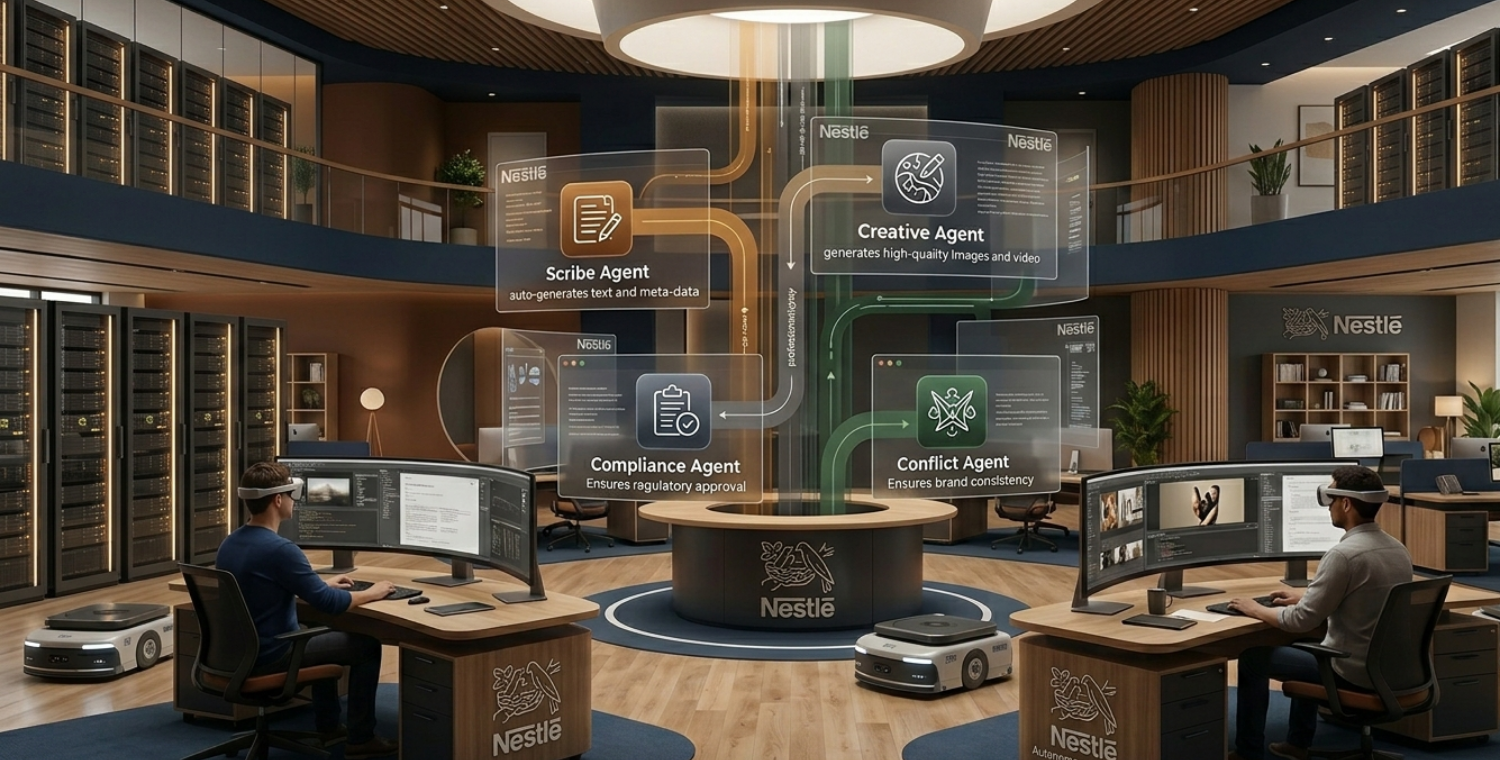
Persistent ‘forecast volatility’ has been a long-standing operational hurdle for Nestlé. With thousands of SKUs and perishable ingredients, traditional forecasting often led to overproduction, high waste, or critical stockouts at major retailers. This “Inventory Gap” meant that billions of dollars in capital were tied up in “safety stock” that either spoiled or moved too slowly.
On January 2, 2026, Nestlé announced the full-scale integration of its Autonomous Supply Chain engine. Powered by NVIDIA Blackwell-accelerated machine learning models, this system shifts the company from “Reactive Forecasting” to “Proactive Demand Sensing,” where the supply chain self-adjusts based on real-time consumer data, weather patterns, and global logistics flow.
The Challenge: The “Demand Sensing” Bottleneck
In FMCG, consumer demand is non-linear and affected by millions of external signals. Traditionally, planning cycles were monthly or weekly, which was far too slow for 2026’s “Always-On” digital commerce. The “Response Gap” meant that the supply chain couldn’t pivot quickly enough when a sudden trend spiked or a shipping lane was blocked.
Nestlé’s deployment solves this by providing the compute power to ingest petabytes of global signal data and adjust production schedules autonomously.
The Solution: The Blackwell-Powered “Predictive” Stack
The centerpiece of this deployment is a high-performance cluster of NVIDIA Blackwell GPUs running Nestlé’s proprietary demand-sensing algorithms.
Key Technology Deployment Pillars
| Pillar | Technology Integrated | Primary Function |
| Compute Engine | NVIDIA Blackwell GPUs | Processes massive global datasets for real-time demand forecasting. |
| Forecasting Model | Deep Learning Predictive Engine | Analyzes weather, social trends, and retail sales signals simultaneously. |
| Execution Layer | AI-Driven Warehouse Management | Automatically shifts stock allocation based on real-time regional demand. |
| Data Security | Sovereign Cloud Nodes | Ensures supply chain logic and vendor data remain protected globally. |
Phase 1: Deploying the “Demand-Shaping” Strategy
The first phase focuses on replacing human-led forecasts with autonomous AI-driven demand sensing.
- The Use Case: Managing the complex distribution of shelf-stable and perishable goods across 190 countries.
- The Action: The AI engine ingests real-time signals (e.g., local events, competitor price drops, weather) and automatically updates production orders for factories.
- The Result: Forecasting errors were reduced by 30%, significantly lowering food waste and storage costs.
Phase 2: Solving the “Predictive Maintenance” Crisis
Beyond demand, Nestlé is using AI to ensure the factories themselves don’t fail.
- The Use Case: Reducing unplanned downtime in high-speed bottling lines.
- The Action: IoT sensors on production lines feed data to the Blackwell cluster, which predicts component failure days before it happens.
- The Result: Equipment stoppages decreased by 45%, and the lifespan of critical machinery increased by 30%.
Operational Impact of Nestlé AI Deployment (2026 Metrics)
| Metric | Traditional Supply Chain (2024) | Nestlé Autonomous AI (2026) |
| Forecasting Error | Baseline (100%) | 30% Reduction |
| Equipment Downtime | High (Unplanned) | 45% Decrease (Predictive) |
| Inventory Levels | High (Safety Stock) | 15-20% Lower (Optimized) |
| Response Latency | Days (Manual) | Minutes (Autonomous) |
Phase 3: The “Resilience-by-Design” Advantage
Nestlé’s deployment uses “What-If” scenario planning to build resilience. If a port closes or a supplier fails, the AI automatically simulates the entire global network to find the optimal path forward within minutes. This gives Nestlé a “Sovereign Supply Chain” advantage—they don’t just react to disruptions; they design their way around them before they impact the store shelf.
The Results: A New Paradigm for Global Supply Chains
Nestlé’s shift to an autonomous AI organization is already redefining global logistics.
- Deployment Success Summary:
- Zero-Waste Logistics: Real-time demand sensing has reduced perishable goods waste by 22% globally.
- Hyper-Localized Distribution: AI agents adjust regional stock 5x faster than manual teams, ensuring 99% on-shelf availability during peak seasons.
- CO2 Reduction: By optimizing truck routes and reducing overproduction, Nestlé has cut its supply chain emissions by 18% in 2026.
Conclusion: The End of the “Guesswork” Supply Chain
The deployment of the Blackwell-powered Autonomous Engine marks the end of the “Spreadsheet-led” supply chain era. By bringing real-time intelligence to every node, Nestlé is ensuring that its products are always where they need to be, at the lowest possible cost. In the FMCG race, the winner isn’t just the one with the most brands, but the one who can balance the global scale at the speed of demand.