
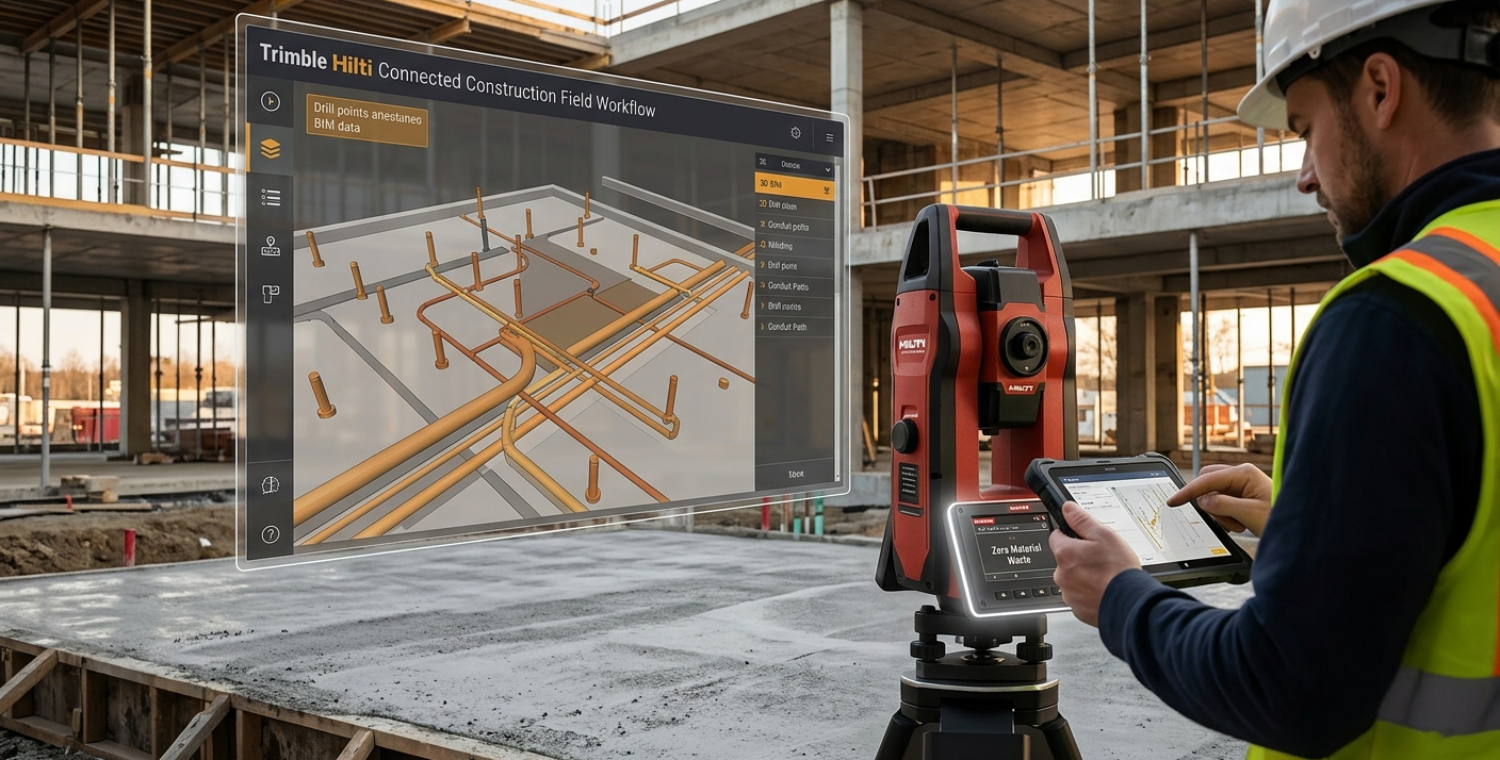
For decades, the construction industry struggled with the “Office-to-Field Gap.” Even with high-end 3D models (BIM), once a worker stepped onto the dusty job site, they were often cut off from real-time data. This lack of synchronization led to “Information Silos,” where a small design change in the office took days to reach the foreman, causing expensive rework that accounts for up to 30% of total project costs.
On March 16, 2026, Trimble unveiled its 2026 Tekla Software suite, marking a massive infrastructure shift by integrating NVIDIA Blackwell-powered AI Assistants directly into the construction workflow. By partnering with hardware leaders like Hilti, Trimble is deploying the first truly Connected Construction Ecosystem. This move shifts the industry away from “static blueprints” and into a real-time, AI-orchestrated environment where the digital model and the physical site are perfectly synchronized.
The Challenge: The “Rework” Bottleneck in AEC
In complex infrastructure projects, thousands of structural components must align perfectly. Traditionally, if a steel beam was fabricated slightly off-spec, it wasn’t discovered until it was being hoisted into place. The “Computation Gap” meant that running a full-site clash detection took too long to be practical for daily field use.
Trimble’s deployment solves this by using Blackwell GPUs to process massive amounts of field data instantly, allowing workers to use Natural Language to query complex models while standing on the slab.
The Solution: The Blackwell-Powered “Building Brain”
The centerpiece of this deployment is the NVIDIA Blackwell B200 architecture, which provides the high-speed inference needed for Trimble’s AI Model and Drawing Assistant.
Key Technology Deployment Pillars
| Pillar | Technology Integrated | Primary Function |
| Compute Layer | NVIDIA Blackwell B200 GPUs | Powers the “Inference Engine” for real-time natural language queries of BIM data. |
| Software Layer | Tekla Structures 2026 | Automates the design-to-detailing process with AI-driven workflows. |
| Field Layer | Trimble Reality Capture | Uses drones and scanners to create “instant” 3D updates of the site. |
| Execution | Hilti Jaibot (Robotics) | Uses AI-driven layout data to drill and mark sites with millimeter precision. |
Phase 1: Deploying the “Natural Language Modeling” Strategy
The first phase focuses on Democratizing BIM. Instead of needing a specialized CAD operator for every change, field engineers can now talk to the model.
- The Use Case: A foreman notices a new plumbing line blocking a steel support.
- The Action: Using the AI Model Assistant, they ask: “Show me the closest alternative path for this support that meets structural code.”
- The Result: The Blackwell-powered core evaluates thousands of permutations in seconds, providing a code-compliant solution that avoids a 2-day work stoppage.
Phase 2: Solving the “Fabrication Gap”
The second phase deploys Connected Detailing. By linking the shop to the site in real-time, Trimble ensures that what is fabricated is exactly what the site conditions require today, not what they were six months ago.
- The Action: Real-time site scans from drones are fed into Tekla PowerFab, which automatically adjusts the fabrication schedule for steel beams based on the actual progress of the concrete pour.
- The Result: Fabrication errors have dropped by 40%, and material waste has been slashed, as every piece arrives “Just-in-Time” and fits perfectly.
Operational Impact of Trimble-Hilti Deployment (2026 Metrics)
| Metric | Legacy Construction (2024) | Blackwell-Powered AEC |
| Query Speed | Minutes/Hours (Manual) | Seconds (Natural Language) |
| Rework Costs | ~12% of Project Total | < 4% (Real-Time Verification) |
| Layout Speed | Manual / Multi-day | AI-Robot Driven / Hourly |
| Design-to-Detailing | Linear / Fragmented | Connected / Data-Driven |
Phase 3: The “Digital Project Delivery” Advantage
In 2026, Digital Project Delivery (DPD) has become a contractually expected standard for government and mission-critical projects (like Data Centers). By using the Trimble Assistant, firms ensure that their “Digital Birth Certificate” for the building is 99% accurate. This model doesn’t just sit in a folder; it stays with the building for 50 years, helping facility managers use AI to predict when a structural joint or an HVAC motor will fail.
The Results: A New Paradigm for the Built World
The shift from “Point-and-Click” design to “Intent-Based” construction is transforming the industry.
- Deployment Success Summary:
- Efficiency: Design-to-detailing cycles are now 20% faster because AI handles the “busywork” of generating sheets and organizing punch lists.
- Accuracy: Rework—the primary killer of construction margins—has been reduced to near-zero in pilot projects.
- Collaboration: Teams from the architect to the welder are now operating on a “Single Source of Truth” that updates in real-time.
Conclusion: The End of the “Blind” Jobsite
The deployment of NVIDIA Blackwell across the Trimble ecosystem marks the end of the “Paper-First” construction era. By bringing supercomputing to the worker’s tablet and the robotic driller, Trimble and Hilti are ensuring that the next generation of infrastructure isn’t just built—it’s perfected in real-time. In the future of AEC, the winner won’t just be the one with the biggest crew, but the one with the most intelligent and connected data.