
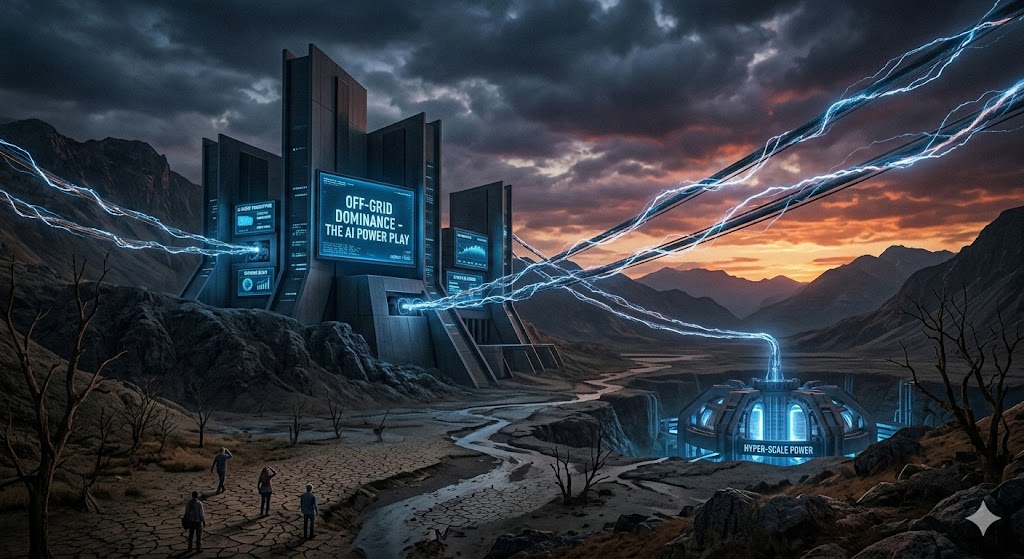
In the relentless pursuit of artificial intelligence, Big Tech companies are building private power grids to fuel their AI data centers. This strategic move has profound implications for our environment, economy, and communities. As AI’s computational hunger grows, so does its thirst for power and water, pushing tech giants towards isolated, off-grid solutions that promise independence but threaten to exacerbate a looming global resource crunch.
The Unseen Infrastructure: Powering the AI Revolution
The scale of this ambition is staggering. Projects like the GW Ranch in West Texas envision 8,000 acres for an entirely off-grid data center, projected to consume more energy than Chicago
. These undertakings, across several states, are driven by a singular imperative: to bypass traditional utility grid limitations. By generating their own electricity, primarily through natural gas and solar panels, tech companies aim for uninterrupted power for their burgeoning AI operations, free from public infrastructure constraints.
This trend is a concerted effort by industry titans such as Meta, OpenAI, Oracle, and Chevron. Some states facilitate this shift with legislation designed to ease the establishment of these self-sufficient data centers. For instance, a planned off-grid data center in West Virginia will include a gas plant capable of powering every home in the state, highlighting the immense energy capacity these private grids command.
The race for AI dominance has transformed into a race for energy independence, with data centers rolling out at breakneck speed to meet AI’s immense computational needs.
Environmental Crossroads: Emissions, Water, and Local Resistance
While solar power offers a veneer of sustainability, heavy reliance on natural gas for consistent output in these off-grid facilities presents a significant environmental dilemma. This increased dependence on fossil fuels means a surge in emissions, directly contradicting global climate efforts. Experts like Michael Thomas of Cleanview warn this approach is “catastrophic for climate goals,” identifying 47 such off-grid projects.
The environmental cost of powering AI is becoming increasingly apparent, raising urgent questions about the true sustainability of this technological leap.
Environmental impact extends beyond carbon emissions to water. Data centers are notoriously water-intensive, primarily for cooling servers. A single large data center can consume up to 5 million gallons of water daily, equivalent to a town of 10,000 to 50,000 people.
This immense demand exacerbates water scarcity, particularly in arid regions, leading to significant local opposition. Communities, like Tucson, Arizona, have defeated data center proposals, citing concerns over water usage and potential for inflated energy bills.
The pursuit of AI infrastructure thus creates a direct conflict with local resource management and environmental stewardship.
Economic Ripples: Who Pays the Price?
The economic ramifications of Big Tech’s energy independence are complex and far-reaching. Jigar Shah, an energy entrepreneur and former federal energy official, points out that these tech companies, with their virtually limitless resources, will compete with public utilities for maintenance and equipment.
This competition could drive up costs for essential infrastructure, forcing public utilities to invest more in maintaining older systems. The inevitable consequence, Shah warns, is that these rising maintenance expenses will be passed to typical ratepayers, leading to higher electricity bills for ordinary citizens.
The promise of off-grid independence for tech giants could translate into increased financial burdens for the general public.
This dynamic has not gone unnoticed politically. Former President Trump has championed Big Tech generating its own power for AI data centers, framing it as a measure to protect Americans from rising energy costs. A forthcoming White House meeting is expected to see major tech players sign a “ratepayer protection pledge”.
However, critics, including some Democrats and environmental groups, argue these pledges are largely symbolic and do not guarantee lower energy bills. They advocate for tech giants to cover the full infrastructure costs associated with their massive energy consumption, rather than allowing these costs to be indirectly borne by the public.
This debate highlights the tension between fostering technological innovation and ensuring equitable environmental and economic outcomes.
A Future Powered Differently?
The race to build private power grids for AI data centers is a testament to AI’s transformative power, but it also highlights the urgent need for sustainable solutions. While some companies explore advanced cooling systems to reduce water usage, and others pledge to match energy consumption with 100% clean and renewable energy, the scale of the challenge remains immense. The future of AI, and indeed our planet, hinges on finding innovative ways to power this new era of intelligence responsibly, ensuring progress doesn’t come at an unsustainable cost to our shared resources.
References
[1] “AI data centres are driving an energy and water crunch …” Corporate Knights,
[2] “How water can unleash growth in the era of AI” World Economic Forum,