
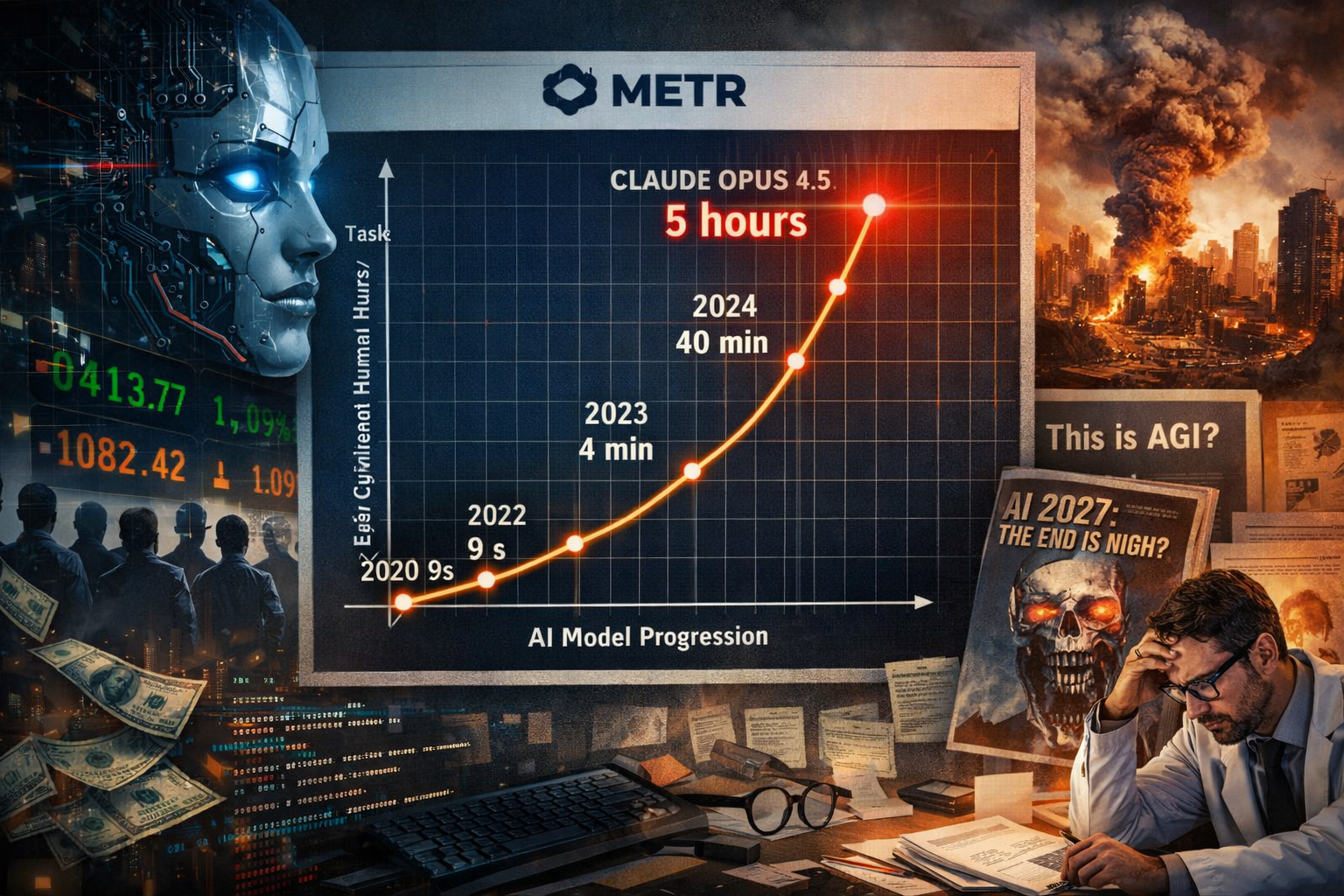
Every few months, a new frontier AI model drops — and before anyone can even read the technical report, the internet turns its eyes to a single graph published by a small AI safety nonprofit called METR. For many observers, this chart has become the closest thing the AI world has to an oracle. It has sparked doomsday predictions, billion-dollar investment theses, and at least one Anthropic employee tweeting “mom come pick me up I’m scared.” There’s just one problem: almost everyone is reading it wrong.
The Graph That Launched a Thousand Hot Takes
METR — which stands for Model Evaluation & Threat Research — first published its now-iconic “time horizon plot” in March 2025. The graph shows a clean, steep exponential curve climbing upward with each new AI model release. It looks simple. It feels profound. And it has been passed around on social media so many times, stripped of all context, that its actual meaning has been almost entirely lost in translation.
When Anthropic released Claude Opus 4.5 in late 2025, METR updated the plot — and the results were explosive. Opus 4.5 appeared to hit a five-hour mark on the y-axis, far outpacing the already-impressive trend line. Researchers panicked. Commentators proclaimed the end of the knowledge worker. Venture capital firm Sequoia Capital published a post boldly titled “2026: This Is AGI.” The viral sci-fi forecast AI 2027, which used the METR plot to predict a superintelligence-induced extinction by 2030, racked up millions of readers.
But the researchers who made the graph were watching all of this with growing discomfort.
What the Y-Axis Actually Means (It’s Not What You Think)
Here is the central misunderstanding, and it is a significant one. When people see “5 hours” on the METR graph’s y-axis next to Claude Opus 4.5, they assume it means the AI can independently work for five hours straight. That would indeed be remarkable. But that is not what the metric measures.
What METR actually calculated is called a “time horizon” — a carefully defined number representing how long it takes humans to complete the tasks that a given AI model can successfully finish about 50% of the time. In other words, a five-hour time horizon means the model can reliably complete tasks that, for a skilled human, would take roughly five hours of work. It says nothing about whether the AI can sustain independent effort for five hours, plan across long timeframes, or handle novel real-world challenges.
Thomas Kwa, one of the lead authors on the original paper, noticed this error so frequently that he made correcting it the very first line of a January 2026 clarification post. “I would include the word ‘human’ whenever the task completion time was mentioned,” he told MIT Technology Review. It sounds like a small tweak. The implications are enormous.
A Benchmark Built on Coding — And Only Coding
Beyond the definitional confusion lies a deeper limitation: the METR plot is built almost entirely on software engineering and coding tasks. The methodology is rigorous within its domain — METR assembled a large suite of tasks, timed expert human coders completing them, and then measured how models performed as task complexity scaled up. It’s genuinely one of the most carefully designed AI evaluations in existence, as even skeptical researchers have acknowledged.
But a model excelling at coding tasks doesn’t magically translate to broader human-level competence. “A model can get better at coding, but it’s not going to magically get better at anything else,” says Daniel Kang, a computer science professor at the University of Illinois. The real world is also far messier than controlled benchmarks. METR’s own research shows that models perform noticeably worse on “messy” tasks — those where the AI doesn’t know exactly how it’s being scored, or can’t easily backtrack from a mistake. Most real jobs are exactly this kind of messy.
The Hype Machine Always Strips the Caveats
What makes METR’s situation unusual — and a little uncomfortable — is that the organization is fundamentally a safety organization. Its mission is to assess existential risks from AI, not to cheerfully forecast exponential progress. Yet its most famous output has become a rally flag for AI accelerationists, doomsayers, and venture capitalists alike.
“I think the hype machine will basically, whatever we do, just strip out all the caveats,” Kwa says, with evident resignation. His colleague Sydney Von Arx puts it more colorfully: “It’s a little weird when the way lots of people are familiar with your work is through this pretty opinionated interpretation.”
Despite everything, the METR team stands behind what the graph does say. The trend is real. AI capabilities, measured on coding benchmarks, are doubling approximately every seven months. Models that could handle nine-second human tasks in 2020 graduated to four-minute tasks by 2023 and forty-minute tasks by late 2024. That is genuinely remarkable progress — even if it falls well short of the apocalyptic or utopian narratives it has been recruited to support.
A Useful Tool, Not a Crystal Ball
The METR time horizon plot is best understood as what it was always intended to be: a scientific instrument, not a prophecy. Like any instrument, it has a specific range and purpose. It measures something meaningful — the growing capacity of AI to tackle complex, time-intensive tasks in a structured environment — without telling us much about when AI will replace your doctor, take over the economy, or bring about the singularity.
“You should absolutely not tie your life to this graph,” Von Arx says. But she also believes the trend it captures is real: “I bet that this trend is gonna hold.”
That’s about as honest as science gets. In a domain drowning in hype and fear in equal measure, the most radical thing METR’s graph might actually be saying is this: progress is real, measurable, and more mundane than you imagined — and that’s still worth paying very close attention to.
References
1.MIT Technology Review
2.METR Time Horizon Blog
3.Sequoia Capital
4.METR Jan 2026 Limitations Post